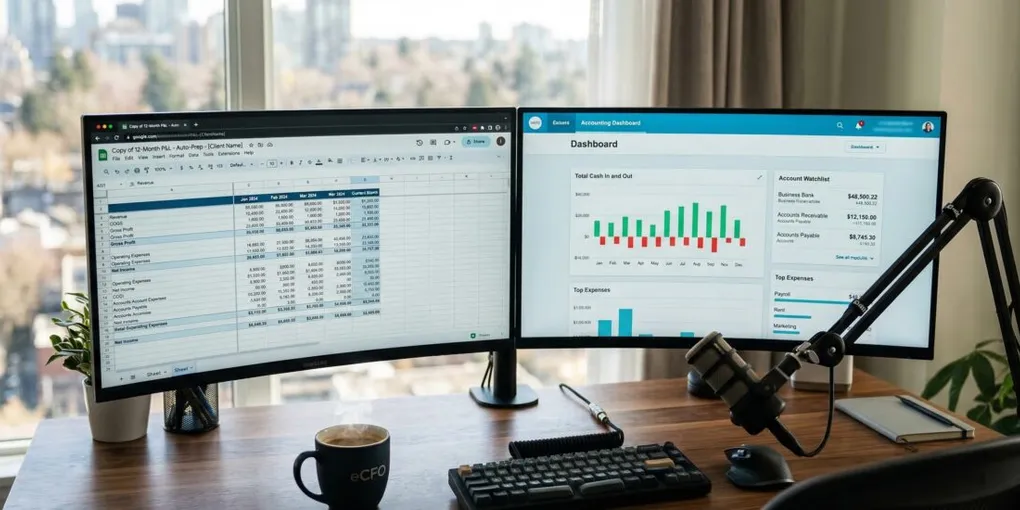
How I Automated My vCFO Meeting Prep with AI (The Intern & The Manager)
If you are a vCFO, an accountant, or a strategic advisor, you know the drill. It’s two days before your monthly client meeting. You pull up their Xero file, export the Profit & Loss, run a Balance Sheet, and start staring at the numbers, wishing you could just automate vCFO meeting prep.
Dashboards, whether in Xero, Fathom, or Looker, are great at telling you the “what.” They show you that revenue is up 5% or that Accounts Receivable has blown out to 45 days.
But dashboards don’t tell you the “why.” And more importantly, they don’t formulate the probing, strategic questions you need to ask the founder to provide actual direction for their business. Translating raw data into an advisory conversation takes time. Or, at least, it used to.
Recently, I decided to build a system that runs on autopilot, using a combination of Google Sheets, Google Docs, and the Gemini AI API.
Here is how I built a system that does the heavy lifting for me, using the classic “Intern and Manager” dynamic.
The Tech Stack (What You Need to Build This)
If you want to implement this in your own firm, the barrier to entry is surprisingly low. Here is exactly what I use:
- A Data Connector: A tool like G-Accon (or your own custom script) to automatically pull Xero data into spreadsheets.
- Google Workspace: Google Sheets acts as the control center, Google Docs serves as the output, and Google Apps Script is the glue that holds it all together.
- Gemini API Key: This is the cognitive engine that analyzes the data. A Critical Note on Security: As a vCFO, data privacy isn’t optional; it’s the foundation of my practice. I run the Gemini API on a paid Google Workspace plan. This ensures that my clients’ highly sensitive financial data remains strictly within my private domain and is never used to train public AI models.
Step 1: The intern (gathering the data)
Every good firm needs someone to do the grunt work. In my automated firm, the “Intern” is a data connector (like G-Accon or a custom script) that speaks directly to Xero.
Every night, while I’m sleeping, the Intern quietly pulls the latest P&L and Balance Sheet data from Xero and drops it into a hidden Google Sheet. There’s no formatting, and no styling. Just raw, up-to-date numbers. The Intern’s only job is to ensure the data is there when we need it.
Step 2: The manager (synthesizing the insights)
Having raw data is useless without context. This is where the “Manager” steps in. The Manager is a custom Google Apps Script I wrote, powered by the Gemini AI API.
I keep a “Foundational Reference” Google Doc for every client. This is my ongoing diary of the client’s strategic goals, historical quirks, and long-term plans.
I built a central “Control Center” in Google Sheets. I just type in the date of my next client meeting, and 48 hours before that meeting, the system wakes up:
- It grabs the raw numbers from the Intern.
- It grabs the context from the Foundational Reference Doc.
- It hands both to Gemini with a specific prompt. The beauty of this is the flexibility. Because I built the prompt system inside Google Sheets, I can change the AI’s focus on the fly. If a client is in growth mode, I assign a “Growth Prompt.” If cash is tight, I switch a dropdown to my “Cashflow Prompt,” forcing the AI to ignore vanity metrics and hunt ruthlessly for cash traps and working capital anomalies.
The system scales infinitely. Whether I have 5 clients or 50, the script loops through them all.
Step 3: The delivery (How to automate vCFO meeting prep)
Once the Manager (Gemini) analyzes the data against the client’s history, it generates a beautifully formatted Google Doc filled with targeted questions, anomaly flags, and strategic talking points.
It drops the Doc into the client’s folder and pings me on Google Chat with the link. I haven’t clicked a single button.
The critical truth: AI is not the CFO
This system is incredibly leveraged. It saves me hours of prep time every single month. But we need to get one thing absolutely straight: The AI is not the CFO.
As Harvard Business Review famously noted, AI won’t replace humans, but humans with AI will replace those without it.
The AI is a brilliant analyst. It’s a second set of eyes that ensures I don’t miss a subtle shift in gross margin. But the AI doesn’t have empathy. It doesn’t understand the nuance of the founder going through a divorce, or the stress of an impending product launch.
The expertise, the domain knowledge, and the strategic advisory sit entirely with the human in the loop. The AI tees up the ball; the human vCFO swings the club, guides the conversation, and helps the client implement the strategy.
By automating the “Intern” and the “Manager” roles, I don’t work less. I just spend 100% of my time doing the high-value human work that software can’t do.
(Want to see more of how I’m building an automated finance tech stack? Check out my recent post on Automating Xero Invoicing with an AI Agent